Monday, April 16, 2012

A River of Change

We've all heard the phrase, "You can't step into the same river twice."  Though Heraclitus apparently made this statement over 2500 years ago, I've found it to be applicable to several trout streams this season. 

I haven't been fly fishing long, so I haven't had a chance to really get to know one particular stretch of water yet.  That's starting to change this season.  I've hit a lot of different streams this spring, yet most of them I've fished previously at one point over the past couple years.  It's been interesting to return to familiar stretches of water where I've caught fish before and know where the trout are lying. 

It's also very interesting to see the same stretches of water fish so differently on different days, whether that means during different seasons or just different days of the week.  It amazes me how differently the trout act depending on sun/clouds, warm air/cold air, rain/dry.

On one particular stretch of stream that I've managed to fish on three separate occasions this past month, I've had three very different fishing experiences.  On my first visit, the rain had just subsided and I was faced with bluebird skies, wind, and warm temperatures.  The trout were very spooky, but I managed to get some on a Royal Wulff with an olive caddis emerger as a dropper.  My second visit was on a cloudy, cool, and damp day.  The trout made it easy, and though there were #20 and #22 olives and midges hatching, I had success with the "Usual" and a pink squirrel dropper.  On my most recent visit to this stream, I faced another bright day with spooky trout, but the flies that had worked my first time out were pretty much ignored by the trout this time.  Eventually when the sun started setting, I ended up catching some nice fish on a black X-caddis pattern.

 So obviously the weather impacts trout behavior, whether it's the brightness that makes the fish skittish or the air temperature that determines insect hatches.  Regardless of the influencing factors, I enjoy the fact that trout fishing is not guaranteed to be the same on a particular stretch of stream on any particular day.  I guess I like the challenge of never being able to step into the same stretch of water twice and catch trout the same way each time.


Although these three experiences differed significantly in the fishing, they all shared a few things in common:  trout were caught, good times were had, and new flies were added to my arsenal.


Tuesday, March 27, 2012

Tweed & Cane

The weather has finally begun to feel like it's suppose to during late spring in Wisconsin.  Though the landscape displayed every shade of green imaginable last weekend, the cool temps, clouds, and rain reappeared for a few days, making the Driftless feel more like the chalk streams of England than the Dairy Heartland.  Fittingly, I donned a bit of thrift store tweed for the morning jaunt.
I am still in the process of building up my fly arsenal through tying and buying, but I already have accumulated many flies that have not seen the end of my tippet.  These are flies that have a reputation for catching trout, but I just haven't used them yet.  For that reason, I made the decision  to avoid my "confidence" flies as much as possible this season in order to try out more flies in my box.  It's been easy during my first few seasons of fly fishing to fall back on the half-dozen patterns that always seem to work.  This season I'm going to increase my number of "confidence" patterns--and I'm already off to a great start.  Each time I've hit the water so far this month, I've caught trout on at least two new patterns I had not fished before.  Some of these flies are patterns I've learned in my Thursday night tying class, but others are common patterns everyone knows about that I just have not fished yet. 

This guy/gal helped add one such fly to my confidence arsenal yesterday. 

Besides trying out some new flies last weekend, I also fished with a bamboo rod for the first time.  A friend loaned me their dad's old Orvis Battenkill to use on a couple stretches of water we visited, and I fittingly caught a long, skinny brook trout on my third cast.   
The rod was more whippy than I was use to, and I also had to adjust my muscle memory to the two feet of length that were absent, but there was something very aesthetically pleasing about the deep shades of the cane and the old Pflueger reel on its butt.  A bamboo rod may not be in my near future--I will happily return to my trusty St. Croix graphite for my next outing--but I can appreciate the split cane underworld a bit more now. 

Like a tweed hat on an overcast day, bamboo rods connect you to fly fishing's rich heritage.


Wednesday, March 21, 2012

Out of the Ashes

I've fished with a lot of different people already this season, but today was my first time on the water alone this year.  I was working in the vicinity of very good trout water, so I headed to the stream for the final three hours before sunset. 


It had rained quite a bit earlier in the day, so I knew there was a chance the water would be muddied up.  When I reached the bottom of the valley, I also noticed that the surrounding meadow had recently been burned.  The charred clumps of grass bordered the entire stretch of stream I planned to fish.  I crossed my fingers and hoped that the runoff had had time to sink in or disperse downstream, and looking down from the bridge upon arrival, that's just what had happened.

After a weekend of seeing vehicles at every access point along most of the well-known streams in the area, it was refreshing to have the entire valley to myself.  I had to share it only with the very vocal red-winged black birds setting up their spring breeding territories, the sprinting killdeer, and a couple content equines downstream.

Overall, I had a very good afternoon on the water.  I caught a lot of healthy trout on dry flies--when I could manage a decent drift.  I swear the wind was blowing consistently at 20 mph with gusts up to 40 mph.  It made casting into the narrow slots a bit difficult, and combined with the bright sun, I spooked a hundred times more fish than I caught.  Gale force winds make me appreciate the calm, mosquito infested nights of late summer......as well as the infinite number of ways your line and fly can get snagged.  In hindsight, and as a friend recently suggested, I should have embraced the wind and used it to help move my line rather than fight against it.  Use the force.  Unfortunately, I'm sure I'll have many more opportunities this season to tap into my inner Zen master and become one with the wind.

At least the burned meadow gave me plenty of room for my back casts.  With the black, charred ground all around me, it almost felt like I was fishing on the moon.  It's amazing to see green shoots sprouting to life amidst the carbon blackness of the burned landscape.  It reminds me that fire is life. 

Fire is an essential component of many healthy ecosystems.  Without fire, native plants get choked out and tree regeneration is stunted.  The charred landscape made me think of bur oaks and how their thick bark allowed them to survive many generations of prairie fires.  Whenever I see an ancient, venerable bur oak in the middle of a field in southern Wisconsin, I try to imagine how it once looked surrounded by oak savanna.  Many of the larger bur oaks in this state are old enough to have grown up interspersed within a grassland, which allowed them to develop wide, sprawling branches.  Even though only a few small remnants of the original oak savanna ecosystem of Wisconsin remain, there are still bur oaks around to remind us of our prairie past.

As a child, I daydreamed about going back in time to live a day as a homesteader on the prairie.  I read most of the books written by Laura Ingalls Wilder and definitely believed I would have enjoyed life on the open prairie.  Even today, I get a small thrill from driving through the prairies of North Dakota that others find mind numbingly boring.  I put myself in the setting of My Antonia and imagine a life surrounded by waves and grass, endless skies, and weathered outbuildings.  I've read that some early homesteaders on the Great Plains went crazy from the endlessness of the landscape, but I find the grandeur of the skies and grasslands quite appealing.  I would love to travel back 200 years to see the great seas of grasses dappled by bison herds on the horizon.  I'm not sure I'd like to experience a winter on the Plains or try to outrun a prairie fire, but this landscape puts some sort of spell over me.

While loading up for the drive home, I noticed more life from the ashes.  After decades of trying to control nature, it's comforting to see that, when left to her own devices, Mother Nature can take care of herself.  It's hubris to believe that humans are a necessary cog in the grand wheel that is Planet Earth.  Sure we are starting to remedy our past mistakes by performing prescribed burns, restoring trout streams, and tackling invasives, but don't all environmental issues have Homo sapiens at the epicenter of the problem?  I enjoy the fact that mayflies like this are hatching today, but were also hatching thousands of years ago.  Their life cycles continue on without the faintest nod towards the achievements and follies of the human population.  Observations like this make me feel insignificant in the grand scheme of life, which is strangely comforting to me.


Friday, March 16, 2012

Streamside Therapy

My husband and I normally make a pretty solid team.  My weaknesses are his strengths, and vice versa.  We can usually pick each other up when we're feeling down, but last week we discovered what our kryptonite is:  a dying pet.   With heavy hearts, we said goodbye to Jeffrey last Saturday.


Jeffrey was not your ordinary cat.  He had a lot of special quirks that made him quite amazing, and we're certain we'll never have another companion like him.  Most people who've lived with pets understand how important they can become to you and what an integral role they can play in a household.  Jeffrey was that way.  He was a little guy with a huge personality, and we'll greatly miss his company. 

We've thankfully now arrived at the acceptance stage of our grieving process, but it was touch-and-go for a few days.  After a long period of mourning together, we each chose different ways to dispel our sadness and head down the path towards the sunnier side of life once again.  My husband buried himself in work (partly out of necessity), while I chose streamside therapy.


I was very thankful for the chance to head to the Driftless with a couple good fishing partners the day after Jeffrey was sent to the Great Beyond.  There's nothing like a day on the water to put things in perspective and to refocus your mind on the things that make life good.  The day was the epitome of spring:  warm breezes, blue skies, the smell of rotting humus, and green shoots peeking through mats of dead grass.  There were also the sounds of cranes flying overhead, returning from their southern wintering grounds, and red-wing blackbirds marking their territories in the stubbled fields. 

As the sun sank closer to the horizon, with only the sounds of the breeze blowing and birds singing, we enjoyed some cold beer and watched the tell-tale rings form on the shimmery surface of the stream below.

If that's not a Zen moment, I don't know what is.  Though I'm still catching phantom glimpses of our lost companion multiple times each day, and though I miss him tremendously, my streamside therapy somehow provided closure.  Maybe it was the trance-like state I found myself in while fishing up enticing runs, the refreshing blast of spring air for eight straight hours, the soul-cleansing flow of water, or the good company on the stream.  More than likely it was a combination of many things.....including friends who care enough to send flowers. 
Thanks, Katie and Janie :)


Monday, March 5, 2012

Wednesday, February 29, 2012

For Whom the Bells Tolled

The Earth takes 365.256363 solar days to revolve around the sun.  Only today, on Leap Day, do we notice the extra quarter of a day we accumulate each year.  It's got me thinking about the irrelevancy of the calendar in the grand scheme of things.  Living our lives according to seasons and daylight hours rather than the calendar and clocks might be a refreshing change.  I realize it's not practical for an "advanced" civilization like ours, but wouldn't it be nice to rise with the sun rather than with the alarm clock?  Wouldn't it be nice to plan your life around your core survival rather than a Monday-Friday work schedule?

I saw an eagle at the top of a large tree on my way to school this morning.  The eagle schedules its day around its survival:  it wakes with the morning light, feeds when it's hungry, seeks shelter when it's cold, and roosts when it's dark.  When life gets complicated, I envy the simplicity of mere survival.

Throughout most of my life, a school bell dictated my daily, weekly, and yearly schedules.  As a student for seventeen years and as a teacher for eight years, my comings and goings were directed by a strict bell system.  My school day began with a bell ring at 8:09 am and was followed by bells throughout the entire school day signaling the beginning and end of each period.  My lunch break and bathroom break began and ended with bells.  Another bell signaled the end of my workday.  A bell signaled the start and end of each school year, and bells book-ended the start and finish of spring and winter recesses. 

I didn't realize how restrictive this bell-controlled life was until I left it.  Bells no longer direct my comings and goings these days; my life is now run by a bell-less system set up by my own devices.  I start my day when I need to and work until my work is done.  I eat lunch when I'm hungry, use the bathroom when needed, and sleep when I'm tired.  Within a given year, I work as hard if not harder now than I did when teaching, but the absence of bells dictating my schedule throughout the day provides a freedom that many people take for granted.

Another big change that came with my recent career change involves my time outdoors.  As a student and teacher, much of my day took place in a climate controlled building under depressing fluorescent lights.  During the winter months, I would arrive at school before the sun broke the horizon and not get back home before the sun set.  During this time, the only chance I had to be outdoors was on trips between my car and the high school entrance.  There were many nights when I had an overwhelming urge to take a walk around the neighborhood just to get a breath of fresh air, feel a breeze against my cheek, take in the scent of rotting leaves, and feel some fleeting connection to nature. 

Nowadays, I'm outside for at least ten hours most days--rain, shine, snow, hot, or cold.  My days are now very heliocentric; they're highly influenced by the number of daylight hours and the tilt of the Earth's axis.  This new exposure to the outdoors is a refreshing change.  It keeps me in touch with the phenology of nature, which doesn't always follow a strict schedule based on the Gregorian calendar.  Rather than anticipating the weekend or counting down the days until summer break on the school calendar, I'm now anticipating the advent of spring, the last frost date, the arrival of Japanese beetles, the blooming of hydrangeas, and the first snowfall. 

Though I still hear the muted sound of recess bells tolling on the playground of the nearby elementary school as well as the hourly church bells on Main Street, I am happy to be living life in the absence of this hourly dictator. 

The bells no longer toll for me.

"Today is only one day in all the days that will ever be. But what will happen in all the other days that ever come can depend on what you do today. It's been that way all this year. It's been that way so many times. All of war is that way." 

"There is only now and if now is only two days, then two days is your life and everything in it will be in proportion. This is how you live a life in two days. And if you stop complaining and asking for what you will never get, you will have a good life."  
                                                - Ernest Hemingway, For Whom the Bell Tolls


Saturday, February 25, 2012

Trout Madness

.......or Why Fly Fisherwomen should be Avoided like Wood Ticks

One of the greatest gifts my mom ever gave me was the love of reading. I started to read at a fairly young age and have been a voracious reader ever since. One of my earliest memories involves the two of us sitting on the living room couch while she quizzed me with oversized flashcards. Each card had a capital and lowercase letter from the alphabet along with a colorful image of an item beginning with that letter. I can still see the "Aa" card with a bright, red apple on it. Throughout school, whenever the teacher would be calling on students to read aloud to the class, I would secretly be hoping they'd call on me. I have no doubt that being a good reader at a young age helped set me up for a future of academic success.  I can also picture my younger self reclining in an old, yellow bean bag reading one of the Little House on the Prairie books while the scent of Pledge hung heavily in the air and the noise of my mom's vacuuming drowned out all other sounds. Getting immersed in a good book was a valid excuse for postponing household chores in my family, and I loved getting lost in books; that remains true today.


I still read a tremendous amount of literature, especially during our greenhouse off-season. There's nothing like curling up on the couch with a cup of coffee, a cuddly cat, and a good read.  I even started keeping a literary notebook years ago so I can keep track of the books I go through. A large number of notebook entries over the past few years have been related to fly fishing. One way I've found to keep spirits up during the long closure of the Wisconsin inland trout season is to fly fish vicariously through the writings of other fly fishers. One such book I just completed is Trout Madness by Robert Traver (aka John Voelker). It was a quick and entertaining read that transported me to many remote trout streams in Michigan's Upper Peninsula.

Within the first few pages of this book, I was already hooked by Traver's candid prose. Even his preface contained several proclamations that still ring true today:


…sometimes [a fisherman] fishes not because he regards fishing as being so terribly important but because he suspects that so many of the other concerns of men are equally unimportant.
(p. viii)


In my view the best time to go trout fishing is when you can get away. (p. x)


It's interesting how the simplest phrases are often the most profound.


Because Trout Madness was published in 1960, the hint of chauvinism that appears in a couple chapters is excusable.  If I were to travel back in time to cross paths with John Voelker, I doubt I would be invited to tag along on any of his fishing excursions and would likely be looked upon as a curse to the sport of trout fishing, much like those damn bait fishermen he despises, but I forgive him for this folly (and secretly think I could win him over if given the chance).

 Some of the most enjoyable quotes from Trout Madness allude to the cursed female species:

When [fishermen] aren’t fishing they gabble and prattle about fishing much as clusters of idle women run on about babies and clothes—and the witch-like tendencies of other women. (p. 127)

Ignoring the offensive remark about idle women, Traver's description of the tendency for many fly fishermen to fill up their time off the water by prattling on about anything and everything related to the sport of fly fishing is spot on in my experience.

 And my favorite:

Women Fishermen:  Avoid them.  One kind will quietly out-fish you and generally get in your hair while another variety will come down with the vapors and want to go home just when the rise gets under way. Avoid all of them like wood ticks.
            (p. 144)

I don't think I've ever come down with the "vapors," but I do remember out-fishing some partners on rare occasions.


If something like the above quotes were published in fly fishing literature today, I'm sure you'd hear a huge outcry from both sexes, though I'm not so naive to assume all fly fishermen welcome women into their fishing camps with open arms. I've been lucky in my exploits to come across a good number of fly fishermen who have accepted me into their clan. I doubt they worry about me coming down with the "vapors," but if they secretly regard me as a blood sucking parasite, at least they keep it to themselves.


Tuesday, February 14, 2012

Olives & Hughes

The Wisconsin trout opener is just three weeks away, and I've been spending time filling my fly boxes with tiny flies.  March is the time for "Go Small or Go Home," unless of course you feel like chuckin' some streamers.  The average hook sizes for dry flies that work during the month of March seem to be #18 and smaller.  I use to think that casting anything smaller than a #16 was for crazy folk, but my fly tying must be improving because now a #18 hook seems too big.  I never thought I'd be purchasing #22 dry fly hooks, but that's exactly what I'll be doing this week.  Now I just have to get better at seeing these minuscule flies on the water.......

This past week provided some exciting moments in my tiny world of fly tying.  I completed the third week of a free fly tying class sponsored by my local TU chapter and learned to tie a couple different olive nymph patterns.  There are usually some good BWO hatches in March and April in the Driftless area, so I tied up a small supply of these tiny nymphs.  I also played around with a couple different BWO emerger patterns that I came across.  I really like fishing emergers and cripples.  If I were a feeding trout and had the choice between a hatched insect and one that appears to be stuck in the film, I think I'd automatically go for the emerger or cripple, though I'm not exactly sure what that says about me..... 

I've yet to determine whether trout actually show a preference for emergers during a hatch, but I like fishing them anyway.  Here are two of the prototypes I've been tying lately:
Olive emerger
http://www.riverhouseflyco.com/patterns/rivergod-emerger/
Olive emerger
http://nomadanglers.com/blog/bwo-emerger/


The flies aren't perfect, but I'm sure they'll catch trout this season.  Just as importantly, I like the looks of them.  I'm finding out the more I fly fish, the pickier I become about the flies I use.  There are some flies I just won't tie or fish with because they simply don't appeal to me aesthetically.  I prefer to use flies that look fairly natural, as apposed to fluorescent monstrosities with rubber legs.  Apparently, I've got a tad bit of dry fly snobbery in me as well.  I'll happily fish nymphs if they're working, but I usually use them as a dropper behind a dry fly.  I've also been turning my nose up at streamers lately.  Even though streamers will catch a lot of trout during the spring season when there's not much insect activity on the water, I enjoy my day more by hooking fewer trout on dry flies or emergers.  Regardless, I inevitably end up casting some solo pink squirrels and wooly buggers each spring because, ultimately, my fly pickiness is inversely proportional to the pickiness of trout.

Another exciting fly tying event occurred this past week when I had the opportunity to observe two hours of fly tying by a master.  Dave Hughes was in town for the Badger Fly Fishers spring opener, and he was gracious enough to stop by our class and demonstrate a couple soft hackle patterns.  Though I haven't fished soft hackles before, and despite my previously described snobbery, I may try them out this season because they're pretty looking flies that are pretty easy to tie. During his demonstration to our class, Hughes tied up a March brown spider and a March brown flymph. Along with those #22 hooks, I may also be investing in some partridge hackle.

Dave Hughes tying his March brown spider 
When I first started fly fishing, I quickly began devouring as much information about the sport as I possibly could.  Out of all the books I read pertaining to all things fly fishing, the two most informative books were by Dave Hughes.  I highly recommend Reading Trout Water (previously entitled Reading the Water) as well as Handbook of Hatches because they make complicated information very understandable.  So needless to say, I was very excited to meet him and watch him tie up a couple of his favorite patterns.

It turns out that Dave Hughes has a generous and self-deprecating nature, which are traits possessed by many of the best fly fishermen I know.  So I'm guessing he makes a pretty good fishing partner on top of being a good tying instructor.


With just a few weeks left before the big season opener, I'll be spending many more enjoyable hours in front of my vise.  

Tiny midges are in my future..... 

Tuesday, February 7, 2012

Pieces of Paper

I stand before you the owner of a crisp, new piece of paper.  I officially completed a master's degree last month in natural resources, specifically in the field of environmental education.

Who knew it would be so anticlimactic?

I've always been a huge proponent of education, which likely stems from my familial influence.  Although neither of my parents finished college, it was drilled into my head early on that education was the way to success.  Lucky for me, I breezed through public education and, when it came time for college, it wasn't even a question of IF I was going to college, but rather WHERE I would go.  As it turned out, I only applied to one college, was accepted the fall of my senior year, and headed to UW-Madison on a full ride the following summer. 

I did well in college, but when it came to the end of my sophomore year when most students begin choosing their career paths, I had trouble figuring out what I wanted to do with my life.  It now seems unfair to expect kids at that age to pick out a major that will likely influence a large portion of their working lives.  At the time, my main interests were in the areas of biology, environmental science, and athletics, so in the end I applied to the School of Education where I received my teaching degree.  I taught high school biology and coached basketball and softball for the next eight years.

As a fresh-faced public educator, I wasn't looking to get rich--anyone who says public educators are in it for the money obviously does not know many teachers--but I realized the fastest way to increase my salary was to earn an advanced degree, hence the start of the master's program.  I chose a program in environmental education because I knew it would help improve my classroom curriculum, and being the Granola that I am, I was already interested and well versed in the area.  So through online courses, weeks of summer classes, and roughly $10,000 in tuition expenses, I finally came to the final stages of the program.  That's when I quit my job.

To make a long story short, I left teaching at the end of the 2009-2010 school year in order to help my husband run our small business.  Neither of us regret that decision, but it left me three credits short of completing the now obsolete degree.  There was no question in my mind that I would complete the degree--I had invested too much time and money to fumble at the 1-yard line--so I completed my last course this past summer and pounded out the dreaded THESIS.

It was daunting at the time, but I finally completed my research project last fall, and it can be found in the UW-Stevens Point library system from here to eternity.  It's entitled,

An Evaluation of the Extent to which the Infusion of the Wisconsin Grade 12 Environmental Education Standards into an Elective Biology Course Impacts the Environmental Attitudes of High School Students.

With a title like that, how could anyone pass it up?

So here I sit, staring at this piece of paper that tells me I have an important new degree---a degree that I will likely never use.  If I were still teaching, the skills and knowledge I gained through this degree would definitely be utilized, but as that's not the case anymore, I wonder if this diploma now represents a huge waste of time and money.  I obviously could not have foreseen this outcome when I first began the process, but hindsight is twenty-twenty, isn't it?  With the way my state has started treating public educators, it doesn't look like my teaching salary would have been improved through this degree anyway.  So I'm happy to have completed this master's program, but as stated earlier, it's very anticlimactic.

So for now, this diploma will get tucked away for safe keeping.  Perhaps it will become useful down the road, but just as likely it will not.  On the bright side, I just realized that I was only the second in my family to complete an undergraduate college degree and the first to receive a graduate degree.  I guess that's something to be proud of, and, like my dad said, no one can ever take this new degree away from me........

though I would consider selling it for $10,000.


Monday, January 30, 2012

Hand-Me-Down Bamboo


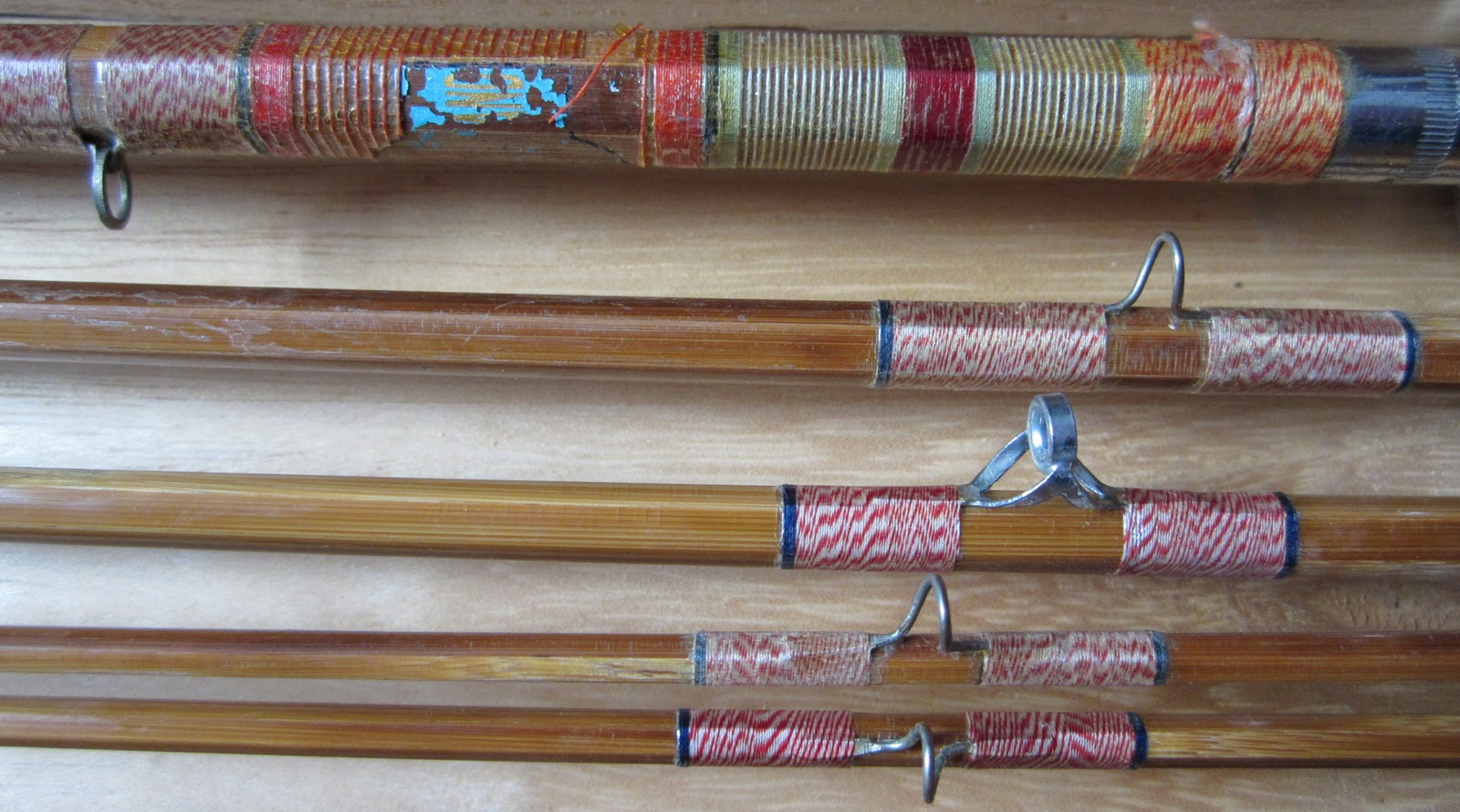
In the world of bamboo fly rods, mine is nothing special.  It’s an 8’ South Bend with interchangeable tips that allow it to be used as a two-piece spinning rod or three-piece fly rod.  From what I've been told, it was mass produced in Japan during the 1940's and 50's.  In terms of aesthetics, it’s seen better days:  some of the wraps are beginning to unravel, the cork grip has taken on an unattractive patina, at least one of the ferrules have come loose, and there's a noticeable bend at the end of the middle section.  I  don't have much experience casting anything other than graphite, but I took it out the other day and made some casts in the backyard with my 5 wt line and reel, which was probably too heavy of a setup for this rod.  Overall, the rod had a very loose feel to it and casted better than I expected it to, but the butt section felt a bit heavy.  Perhaps with a lighter line and reel the casting would improve, assuming the rod stays in one piece. 


Despite these faults, I take great pleasure in this rod because it was a gift from my grandpa   The rod was given to him by a friend that served overseas in Japan, and it apparently has not seen water for at least forty years.  Once I began fly fishing, my grandpa decided it should be taken out of storage and passed on to his oldest granddaughter.

Grandpa Jerry, and the rest of my family for that matter, takes great pride in the fact that I fly fish.  Being a tomboy is a commendable attribute in my family, so they were not the least bit surprised when I took up the sport.  My grandpa likes to tell stories about taking my brother and me out fishing when we were very young.  I clearly remember sitting on a padded bucket on the ice, pulling up blue gills and trying very hard not to complain about the cold.  I also remember staring at panfish flopping in the bottom of metal pails while we cleaned them in my grandparents’ basement.  My grandma would be upstairs heating oil for the imminent fish dinner.  Apparently my grandpa also took us to the Kinnickinnic as young kids to fish for trout, but unfortunately I don’t remember those outings.
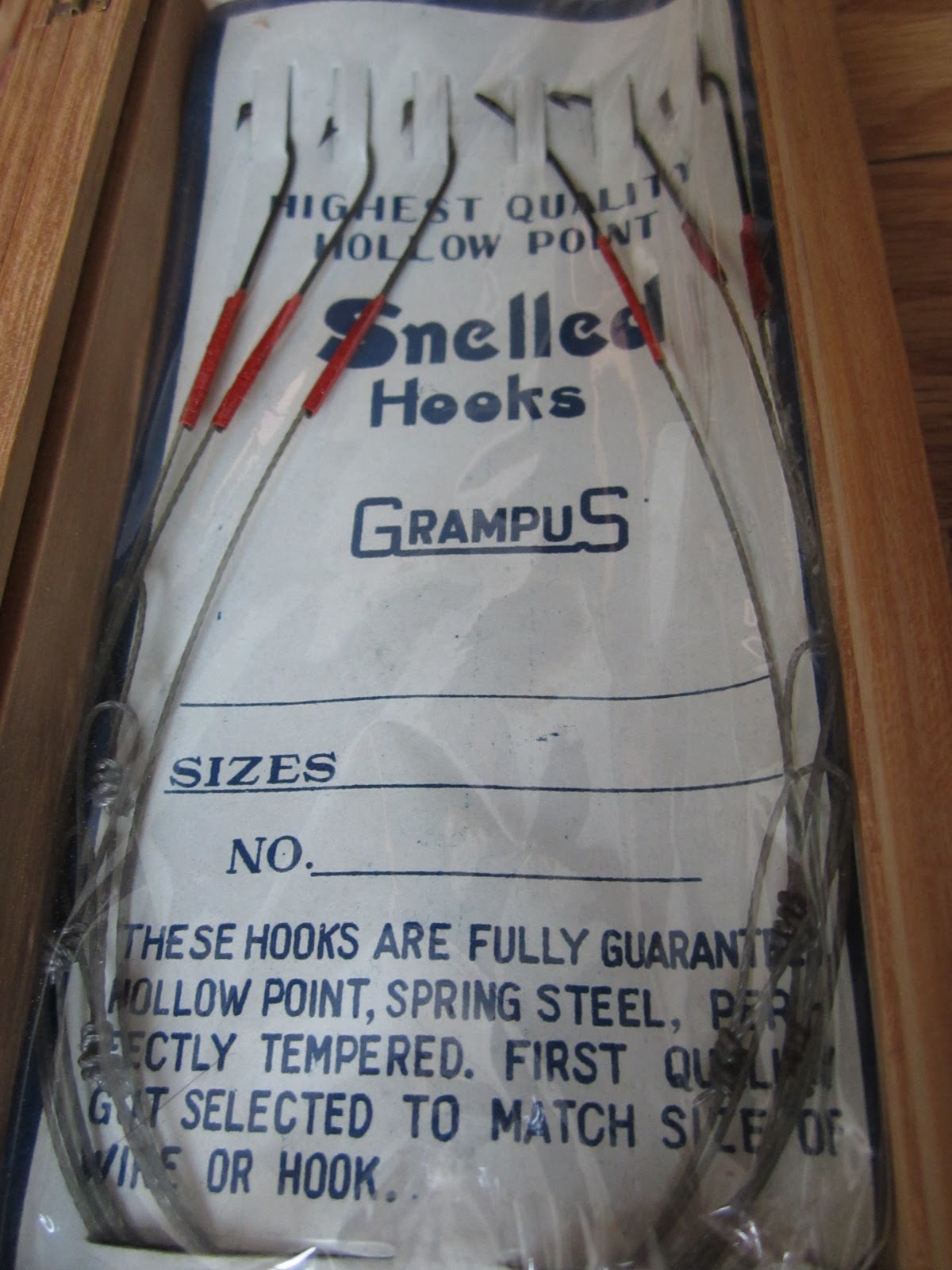
It's interesting to contemplate the rod's history, and I hope to learn more details in the future, but what I find really fascinating are the accessories found inside the rod's box.  The rod is in its original case, which has the look and feel of balsam, and inside the lid are several compartments covered by two sliding covers.  These compartments contain the original silk gut, wired hooks, wooden bobbers, and flies that were sold with the rod.  Though the flies have become a bit disheveled over the years, they look very pretty in their small, individual quadrants.


Since this rod came into my possession, I’ve been content to keep it tucked up high on a shelf out of harm's way, to be brought out and admired occasionally when the desire arises.  Lately, though, I’ve been thinking that this has been a disservice to the rod.  Lately I’ve been thinking this rod deserves to taste water from a spring fed creek.  It deserves to feel warm sunshine along its length.  It deserves to cast a dry fly to a riser and to feel the bounce of a healthy, Driftless trout through each of its fibers. 

For these reasons, I've decided to fish this rod next season and land a trout with it.  Though it makes me a bit nervous to do so, the worst that could happen isn’t as bad as never realizing the potential of the rod. 

It deserves a chance.